🌌 Milky Way & Astro
The 500 rule vs the NPF rule for pinpoint stars

Stars don't sit still — the sky wheels overhead at about 15 degrees an hour, and your shutter is in a quiet race against it. Two simple formulas tell you exactly how long you can expose before a point of light smears into a streak. Learn both and pinpoint stars stop being luck.
Sharp stars aren’t a matter of a steady hand or a lucky night — they’re arithmetic. The Earth turns, the sky appears to rotate, and there’s a hard ceiling on how long your shutter can stay open before each star travels far enough across the sensor to register as a short line instead of a dot. The good news: that ceiling is fully predictable from your focal length, aperture, and sensor. Two rules estimate it. One is fast and forgiving; the other is fussier and far more honest when you zoom in to inspect.
Why stars trail: the sky moves about 15°/hour
The whole problem starts with one fact. Earth completes a turn relative to the stars once every sidereal day — about 23 hours 56 minutes — which works out to roughly 15 degrees of apparent sky rotation per hour. That sounds slow, but a camera magnifies it. Through a lens, a star creeps across your frame second by second, and once it has moved more than a pixel or two (or more than the eye can forgive in a print), the dot becomes a dash.
So a “pinpoint star” shutter time is really the answer to one question: how long until drift blurs a star beyond your tolerance? Wider lenses tolerate longer exposures because each star covers less of the frame per second; longer lenses magnify that drift and cut your time hard. That trade is the engine behind both rules — and it’s the same physics that, run the other way, draws the arcs in how to photograph the Milky Way when you deliberately let stars streak.

The 500 rule: quick, easy, lenient
The classic starting point is the 500 rule. Your longest exposure in seconds is roughly 500 divided by your effective focal length:
t_max ≈ 500 / (focal length × crop factor)
The crop factor corrects for sensors smaller than full-frame (about 1.5× for most APS-C bodies, 2× for Micro Four Thirds), because a smaller sensor crops into the image and magnifies drift just like a longer lens would. Worked examples:
| Lens & body | Effective focal | 500-rule shutter |
|---|---|---|
| 14 mm, full frame | 14 mm | ≈ 36 s |
| 24 mm, full frame | 24 mm | ≈ 21 s |
| 16 mm, APS-C (×1.5) | 24 mm | ≈ 21 s |
It’s easy to do in your head, and for a quick frame on a modest-resolution camera it’s fine. But notice what it ignores: your aperture, and how tightly your sensor packs pixels. A 12-megapixel sensor and a 60-megapixel sensor get the identical answer — which can’t be right, because the high-resolution body resolves the same drift as a longer, more obvious streak. The 500 rule was tuned for the modest-resolution, print-it-small era. On today’s bodies it runs optimistic.
The NPF rule: stricter, sensor-aware, accurate
The NPF rule is the modern correction. It keeps the same goal but factors in the two things the 500 rule drops — aperture and pixel pitch (how physically small each pixel is):
t_max ≈ (35 × N + 30 × p) / focal length
Here N is your f-number (the aperture, e.g. 2.8), and p is the pixel pitch in microns — roughly the sensor’s width in millimetres divided by its pixel-width count, times 1000. A denser sensor has a smaller p; a faster lens has a smaller N. Both push the allowed time down, because both make trailing easier to see when you pixel-peep. (The fuller form of the rule also nudges for a star’s declination — its distance from the celestial equator — since stars near the equator drift fastest and ones near the pole barely move; the app accounts for this so you don’t have to.)
Put real numbers in. Take a 20 mm f/2.8 lens on a 24-megapixel full-frame body, where pixel pitch is about 5.9 µm:
t_max ≈ (35 × 2.8 + 30 × 5.9) / 20 ≈ 13.7 s
The 500 rule gave 25 seconds for that same lens. NPF says under 14. At web size both look fine; at 100% on screen, the 25-second frame shows tiny lines and the 14-second frame shows dots. The denser your sensor, the wider that gap — which is exactly why high-resolution bodies need NPF: their resolving power exposes drift the older rule was never built to see.
Choosing a rule — and the trade-off it forces
A simple way to hold both in your head:
- 500 rule — fast mental math, good enough on lower-resolution sensors or when you’ll only ever view small. Treat its answer as a generous ceiling.
- NPF rule — use it whenever you’ll crop, print large, or shoot a high-megapixel body. When the two disagree, trust the shorter time.
But a shorter shutter has a cost. Less time on the sensor means less light, so you claw it back by opening up the aperture and raising ISO — and higher ISO means more noise (the grainy speckle in dark areas). That’s the central tension of single-frame astro: sharp stars or a clean, bright frame, rarely both at once.
The escape hatch is stacking. Noise is random; the stars and faint detail are not. Shoot several identically framed exposures at your sharp NPF shutter and average them together — the random noise partly cancels while the real signal stays, improving cleanliness by roughly the square root of the frame count (four frames ≈ half the noise, sixteen ≈ a quarter). You get the brightness of a long exposure and pinpoint stars, because every individual frame stayed inside its trailing limit. Keep the camera dead still between frames so they line up.
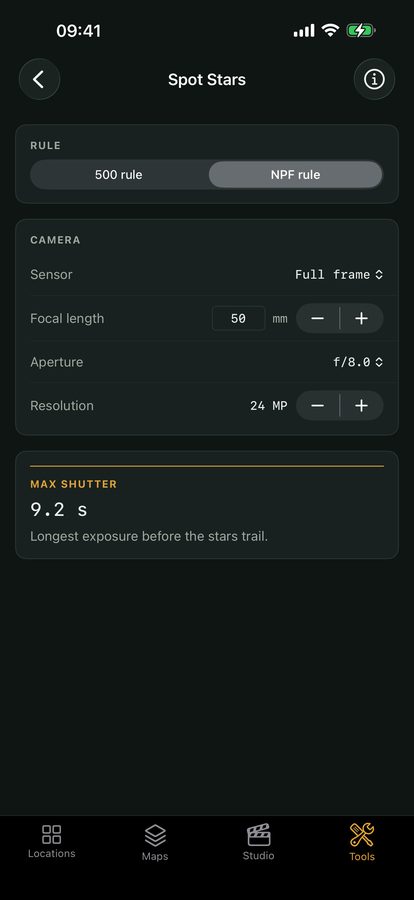
You don’t have to run any of this by hand under a headlamp. The app computes both the 500 and NPF times for your exact lens, aperture, and sensor — alongside the rest of the night-sky photography calculators — so you arrive knowing your shutter before the first frame.
Quick-start checklist
- Remember the cause: the sky drifts about 15°/hour, so shorter is safer.
- Get a fast ballpark with the 500 rule:
500 ÷ (focal × crop). - Tighten it with the NPF rule if you’re on a high-res body or plan to crop or print big.
- When the two disagree, use the shorter time, then open up and raise ISO.
- Manual-focus carefully on a bright star, shoot RAW, and lock the tripod down.
- If the sharp shutter is too dark, stack several identical frames to beat the noise.