🌌 Milky Way & Astro
How to forecast a clear night sky for astrophotography
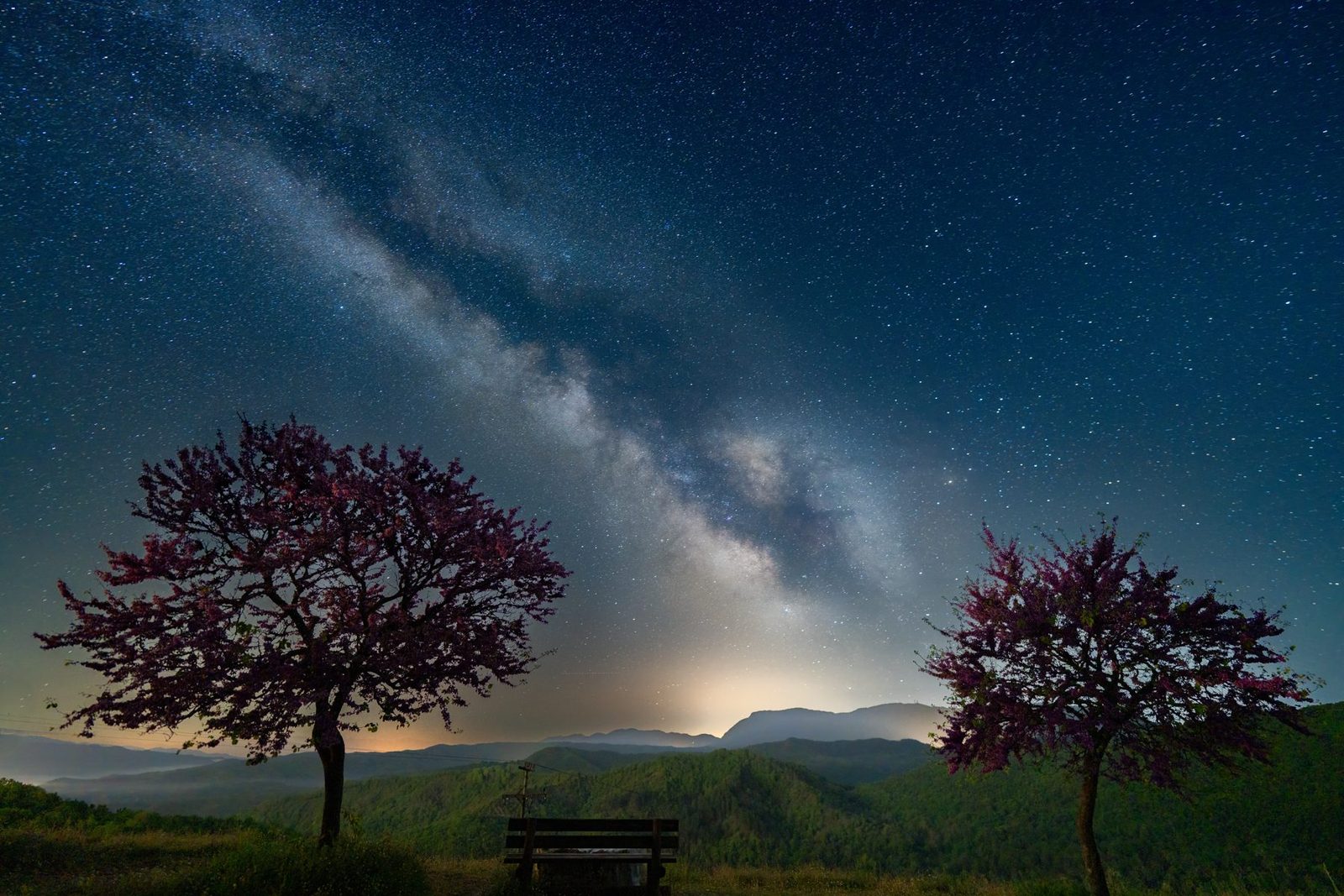
Astro photography is the genre where the forecast decides more than the camera does. You can have the dark site, the perfect moon phase and the core standing exactly where you want it, and a single band of high cloud still ends the night. The good news is that a clear night can be read from a forecast, and the people who get the sky most often are not luckier — they just know which numbers to look at, for which hours, and when to trust them. Here is that method.
A “sunny” forecast and a “clear night” forecast are not the same thing, and the gap between them is where most wasted drives happen. Astro work asks more of the sky than any other kind of photography: not just no rain, but no cloud at all in the part of the sky you are pointing at, air clean enough that faint stars survive the trip, a moon out of the way, and a few hours when all of that overlaps. That overlap is narrow, which is exactly why it is worth forecasting properly.
Start with your window, not the weather
Before you open a forecast, work out when you could shoot at all. Four things have to be true at once:
- The sky is fully dark. That means astronomical twilight is over: the sun at least 18° below the horizon. At high latitudes in summer it never happens, and no forecast can fix that.
- Your target is up. For the Milky Way core that is a few hours a night, and none at all for part of the year (see Milky Way season and timing).
- The moon is down, or thin. A bright moon washes out the faint structure that makes a Milky Way frame. A thin crescent is fine; a gibbous moon high in the sky is not. Moonrise and moonset times matter more than the phase name.
- The sky is clear. This is the only one you cannot calculate, so it is the only one you need the forecast for.
The first three are pure geometry. They are the same on any device, with no connection, to the minute. Work them out first and you have a window — say, 23:40 to 03:10 — and now the forecast has one job: is that specific stretch of hours clear? Checking “tonight” in general is how you end up cancelling a good night over cloud that clears at 21:00 and returns at 04:00 — or driving out for one that is clear at 21:00 and is gone by the time the core is up.
Read cloud in layers, not as one number
A single “cloud cover 40%” figure hides the thing that matters, which is how high the cloud is and how thick.
- Low cloud (stratus, fog banks) is a lid. If it is over you, the night is over. It is also the cloud most worth driving out from under: a ridge or a drive of an hour can lift you above it.
- Mid-level cloud (altocumulus, altostratus) blocks stars and is hard to see at night until the stars start disappearing. Treat it as a no.
- High cloud (cirrus) is the sneaky one. It is thin and fast, so a forecast can show a low total and still ruin the frame: stars dim and soften, a halo grows around the moon, and the Milky Way loses its contrast long before it disappears. A band of cirrus you would not notice at sunset can be the difference between a sharp core and a smear.
So look for low percentages in the hours of your window, and where the forecast lets you, check that the layers are low as well as the total. A night at 10% total cloud is a good one. A night at 30% that is all thin high cloud drifting through is not the same as 30% of small cumulus: the first is a haze over everything, the second is a few gaps you can wait out. Read the hourly numbers, never the day summary, and look for the trend: a front moving out and clearing at midnight is better news than a clear forecast that is getting worse.
Trust the forecast by how far away it is
A forecast is a probability, and the further away it is, the less it knows about cloud specifically (cloud is among the hardest things to predict).
- Five to seven days out: use it to spot the pattern. Is a high-pressure ridge building? Is a front due? That tells you which weekend deserves attention, nothing more.
- Two days out: now it is useful for which night. Rearrange your week around it.
- The day of: this is the one that decides. Check again in the afternoon and again before you leave, because cloud forecasts shift by the hour.
- The last few hours: stop trusting numbers and look. Is the sky to the west — where weather commonly arrives from in the mid-latitudes — clearing or filling? A satellite or radar loop will show whether the cloud edge is moving toward you.
Keep a second place in mind: somewhere an hour away on the other side of a ridge or river, where the cloud may not reach. A good night is often the same forecast for everyone and a different night at the next valley.
Clear is not the same as transparent
Even a cloudless night can look poor, because the air carries haze, humidity, smoke or dust. This is transparency: how much of a faint star’s light survives the path through the air. Wide-field astro depends on it far more than on “seeing” (the twinkling that matters for planets and telescopes, and mostly does not matter for a wide Milky Way frame).
Clean, transparent nights tend to follow cold, dry air — the day or two after a cold front has passed, with a steady northerly or westerly flow. Muggy, humid nights, wildfire smoke days and nights with dust from a distant desert are poor even when the cloud number is zero. If the stars look milky as soon as it gets dark, that is transparency, and there is nothing to do but wait for another night.
Two small numbers that save a shoot
Wind. A tripod and a long exposure do not survive gusts. Under about 25 km/h you will usually be fine with a weighted tripod; above that, find a sheltered spot or accept soft stars.
Temperature and dew point. When the air temperature falls to the dew point, your front element fogs. Look at the gap between them in the forecast: when it is under about 3 °C and closing, bring a dew shield and a heater strap, or the last hour of your session is a fogged lens. (The same gap is what makes fog form, so a night that is good for dew control is sometimes a night for something else altogether.)
Pick the place the dark is cheapest
Darkness is also a place, and the forecast cannot help with it. Light pollution is how much artificial light rises from the ground at a spot; it decides whether the Milky Way is a river or a rumour. The useful way to read it is as a comparison: the number says how much light goes up from the ground there, not how bright tonight’s sky is, so it does not know about cloud, haze or moon. Use it to rank candidates, then find the nearest place that is meaningfully darker and ask whether the drive is worth it (more in finding dark skies).
How Viewpoint helps
The sun, the moon and the Milky Way timetable are the part you can calculate, and the calculators and almanac in Viewpoint do that on your device, free, with no connection: when it is dark, when the moon is up and when the core is above the horizon for your place and date.
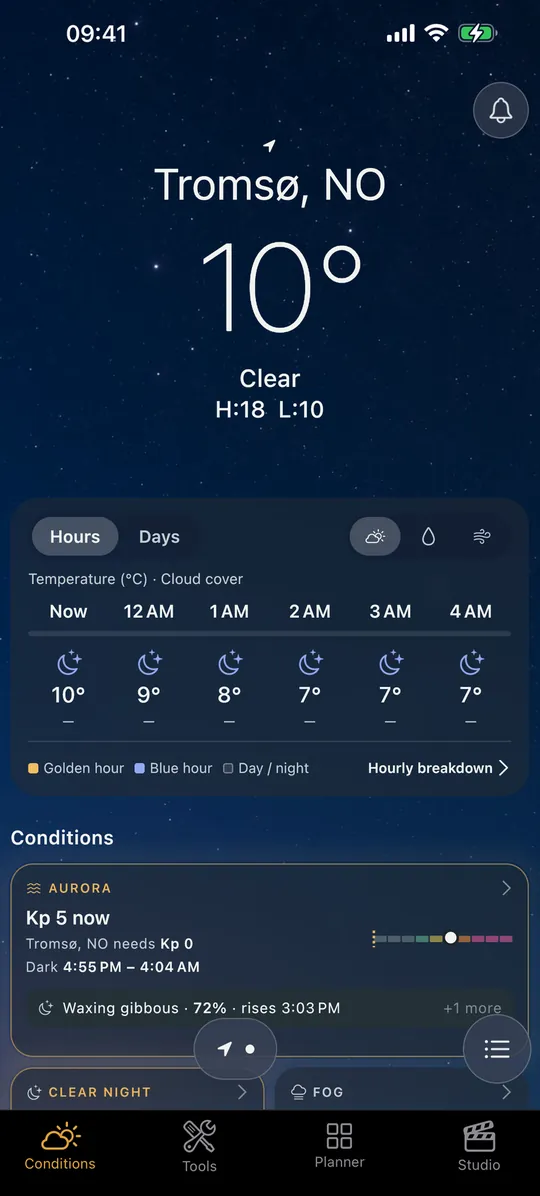
The part you cannot calculate is where the Conditions tab comes in. Each place you follow gets its own page with the hours ahead and the cloud cover along them, a clear night tile with the hours that look best, darkness and moon times, a Milky Way window, and a light pollution tile that lists darker places nearby with the distance and direction. Turn on an alert for a place and Viewpoint notifies you when a clear night is on its way, so you are not refreshing a weather site at midnight. Conditions needs an Online subscription; the calculators and almanac do not.
Quick-start checklist
- Work out your window first: dark, target up, moon down. Then forecast that window only.
- Read hourly cloud in layers; low and mid are a no, thin high cloud quietly kills contrast.
- Trust the forecast by distance: pattern at a week, night at two days, decision on the day, eyes in the last hours.
- Look for cold, dry air after a front for the cleanest transparency.
- Check wind and the temperature–dew point gap before you pack.
- Compare light pollution across candidate places and keep a second spot an hour away.