🌌 Milky Way & Astro
When is the Milky Way visible? Season and timing by hemisphere

The bright heart of the Milky Way is not a matter of luck — it follows a calendar and a clock you can read months ahead. Know the season, the nightly window, and what your latitude does to both, and you can pick the exact night and hour the galactic core stands ready over your scene.
When photographers say “the Milky Way,” they almost always mean one specific part of it: the galactic core, the dense, glowing bulge of stars and dust toward the constellation Sagittarius. The faint band of our galaxy is overhead all year, but the core — the detailed, photogenic part — is a seasonal target that swings into and out of the night sky on a schedule. The good news is that every piece of that schedule is computable. You are never guessing whether the core is up; you are looking it up.
This guide goes deep on the single question of when. For the how — lens, shutter, ISO, focus — see the companion guide on how to photograph the Milky Way.
When can you see the Milky Way from your spot?
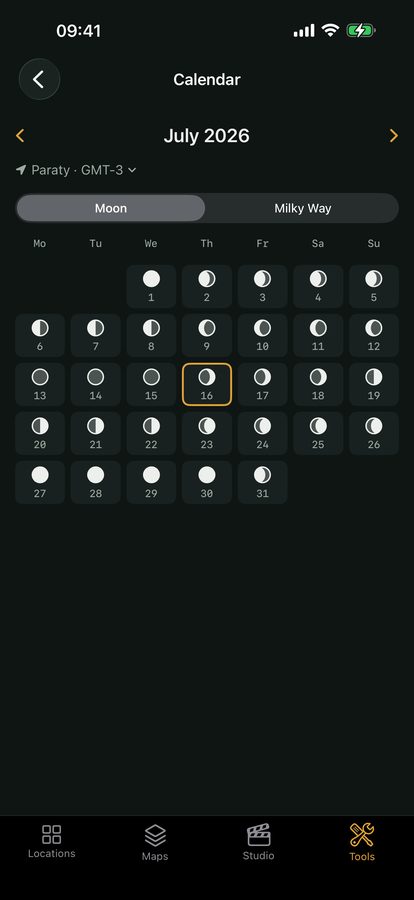
Pick any location and month — this marks the nights the galactic core stands in a dark, moonless sky, worked out on your device.
The three things that must overlap
A night is “shootable” only when three windows line up at the same time:
- The core is above the horizon. It rises in the southeast, arcs across the south, and sets in the southwest (seen from the northern hemisphere). Below the horizon there is nothing to shoot.
- The sky is truly dark. That means astronomical night — the sun more than 18° below the horizon. From roughly 12° to 18° below (astronomical twilight) the sky is still faintly washed; only past −18° does it go fully black.
- The moon is down. A bright moon floods the sky and erases the faint core as surely as a town’s glow. You want the moon below the horizon for your hours, or a thin crescent — which is a moonrise/moonset timing question, not just a phase one.
Your nightly shooting window is the intersection of those three. The season tells you roughly which months the core is up in darkness at all; the nightly almanac tells you the exact minutes. The Sun, Moon & Milky Way almanac computes all three for your date and location at once, so you read the overlap directly instead of cross-referencing three tables.
Northern hemisphere: the season and how the timing slides
From mid-northern latitudes, the core season runs roughly late February through October. What changes across those months is not just whether the core is up, but when during the night — because the core, like every star, rises about four minutes earlier each day, drifting steadily earlier through the season.
| Part of season | Months (approx.) | When the core is up |
|---|---|---|
| Early | late Feb – Apr | Only in the hours before dawn — you shoot, then sunrise ends it |
| Mid | May – Jul | Up for most of the night; the prime, easy window |
| Late | Aug – Oct | Already up at dusk, sets in the evening — shoot early, done by midnight |
So an early-season shoot means a pre-dawn alarm: the core clears the horizon only in the small hours, and you race the coming twilight. By high summer it is convenient — up and dark for a long stretch. By autumn the pattern inverts: the core is already in the southwest as night falls, and you catch it low before it sets, often packing up while the night is still young. Same target, opposite hours, entirely predictable from the date.
Southern hemisphere: higher, longer, centred on winter
South of the equator the geometry works in your favour. From southern temperate latitudes the core climbs far higher — near the zenith rather than skimming the southern horizon — so it reads brighter (less atmosphere and haze in the line of sight) and stays up longer each night. The span of months is broadly the same, but it is centred on the southern winter — roughly the middle of the year — when nights are longest and the core rides highest.
The reason is simply where the core sits on the sky: it lies at a southerly point, so observers in the southern hemisphere look up toward it while northern observers look down toward the horizon. That single difference is why Australia, Chile, and southern Africa are prized Milky Way destinations — the core that grazes the treeline up north stands near overhead down south.
What your latitude does to the season
Latitude — how far you are from the equator — reshapes both how the core sits and how long the season lasts. Two effects compound:
- The core sits lower and shorter the further you go toward the poles. Near the equator the core climbs high and is visible for much of the year; the further north (or south) you travel, the lower its arc and the briefer its nightly appearance.
- Above roughly 55° latitude, summer steals your darkness. Around the summer solstice at high latitudes the sun never drops 18° below the horizon, so astronomical night never arrives — there is no truly dark sky for weeks, whatever the core is doing. This is the cruel overlap: the months when the core is best placed are exactly the months high-latitude twilight refuses to fade. The result is a season that opens late and closes early, pinched into the shoulder weeks on either side of midsummer.
If you are in, say, southern Scotland, much of Scandinavia, or northern Canada, this is the constraint that bites: check that the night actually reaches −18° before you drive out. Lower-latitude shooters rarely face it.
Putting a single night together
Pick a date, then walk the three windows in order:
- Season check. Is the core above the horizon during darkness this month at your latitude? (Northern: late Feb–Oct; southern: similar span, centred on winter.)
- Moon check. Find a night near new moon, or one where the moon sets before — or rises after — your shooting hours. Don’t settle for “new moon” alone; confirm the moon is down for your specific window.
- Darkness check. Read the astronomical-night start and end. At high latitude in summer, confirm it exists at all.
- Core window. Read the core’s rise and set, and take the overlap of all three. That overlap, on a moonless, cloud-free night, is your shoot.
None of this is luck. The sun’s depth, the moon’s position, and the core’s path are all deterministic — which is exactly why you can plan a Milky Way trip months ahead and arrive on the right night. Viewpoint’s almanac and planning tools exist to collapse those three lookups into one answer for your spot and your date.
Quick-start checklist
- Confirm the season for your hemisphere — northern: ~late Feb–Oct; southern: similar span, centred on winter.
- Match the hour to the month — pre-dawn early in the season, all night mid-season, early evening late in the season.
- Find a dark-moon night — new moon, or the moon set/risen clear of your shooting hours.
- Verify astronomical night exists — above ~55° latitude in summer it may never go fully dark.
- Take the overlap of core-up, sky-dark, and moon-down — that intersection is your window.
- Aim south (northern hemisphere) and away from town glow, where the core’s arc lives.