🎒 Gear & Setup
What to pack for a landscape or astro shoot: pack by plan, not habit
There are two ways to pack a camera bag. One is by habit — grab the usual kit and hope — which is how you end up on a dark hillside without a head-torch, or at the coast having forgotten the one filter the shot needed. The other is by plan: you know what you're shooting, when and where, so you pack exactly what that shot requires and nothing you'll just carry. This is a checklist for the second way — a core that never changes, plus what each kind of shoot adds — built from the plan you already made.
A packing list that just says “camera, lenses, tripod” is useless, and a list that itemises every accessory you own is worse — you’ll carry ten pounds of things you don’t need and still forget the one that mattered. The useful version has two parts: a core that goes in the bag every single time, and a small add-on set determined by the specific shoot. And the thing that tells you which add-ons to pack is the plan — the light, the timing and the conditions for the spot you’re heading to. Pack from the plan and the bag is always right and never heavy.
The core kit that doesn’t change
This goes in the bag for every landscape shoot, no thought required:
- Camera + the lens(es) you actually use — for most landscape work a wide and a mid-range cover it; add a telephoto only if the plan calls for compression or distant subjects.
- A solid tripod — non-negotiable for landscape; nearly every technique below assumes one.
- Spare batteries and spare cards — always more than you think.
- A lens cloth — the cheapest thing that saves the most shots.
- A remote release or your camera’s self-timer — to fire without shake.
- Head-torch (with a red mode) — for any shoot that starts before dawn or runs past dusk, which is most of them.
Nail the core and you can shoot something anywhere. The add-ons make it the right something.
What changes for golden and blue hour
A golden-hour shoot is light-and-fast: you’re chasing a moving window, so pack for speed and for holding the sky. Add a graduated ND (or plan to blend exposures) for the bright-sky-dark-land gap, a polariser to cut glare and deepen skies, and warm layers — you’ll be standing still as the temperature drops at dusk. Not much extra; the light does the work.
What changes for the Milky Way and deep night
An astro shoot adds the most, and forgetting one item can end it: a fast wide lens (wide aperture matters more than anything), plenty of batteries (long exposures and cold drain them), a red head-torch (to keep your night vision and not blow out others’ frames), and — if you’re going past the untracked exposure limit — a star tracker and its polar-alignment kit. Warm clothing well beyond what the daytime temperature suggests, because you’ll be standing still for hours in the dark.
What changes for a long exposure
A long-exposure session — silky water, streaking cloud — is about the glass and the stillness. Add your ND filters (and the holder if you use a square system), a way to time exposures past 30 seconds (intervalometer or Bulb release), and be extra careful the tripod is rock-solid — any movement over a multi-second frame ruins it. In wind, add weight to the tripod.
Building your own checklist from a plan
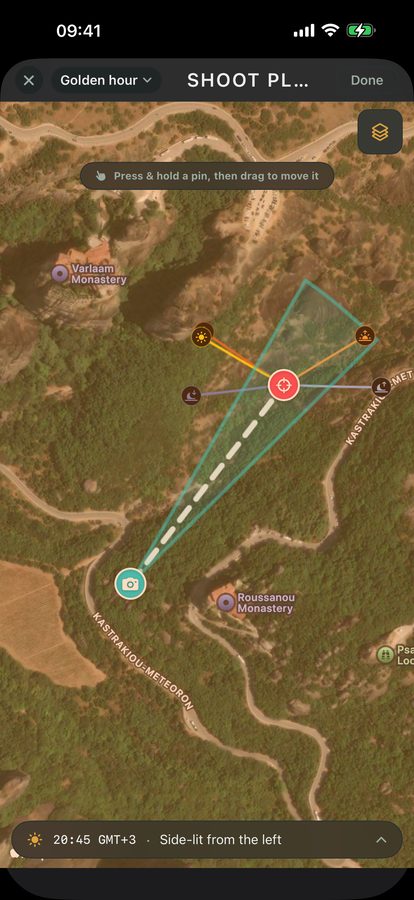
Here’s the habit that makes this effortless: don’t rebuild the packing list from scratch each time — derive it from the shoot plan. Once you know the spot, the light window and the conditions (is it a dawn shoot, a moonless astro night, a long-exposure coast?), the add-on set is decided for you. That’s exactly what a shoot plan in Viewpoint captures — the sun and moon, the timing, the conditions for the spot — so “what do I pack?” is answered by the plan you already made, not by standing over an open bag hoping you haven’t forgotten anything. Pack the core, read the plan, add what it calls for, go.
Quick-start checklist
- Pack a fixed core every time — camera, working lenses, tripod, spare batteries/cards, cloth, release, head-torch.
- Then add for the specific shoot — the plan decides which.
- Golden/blue hour — grad ND or blend, polariser, warm layers.
- Milky Way / deep night — fast wide lens, lots of batteries, red torch, tracker if going long, serious warmth.
- Long exposure — ND filters (+ holder), intervalometer/Bulb, an extra-solid tripod.
- Derive the list from the shoot plan — pack for the shot, not “just in case.”