
🖼️ Composition
How to photograph cherry blossoms
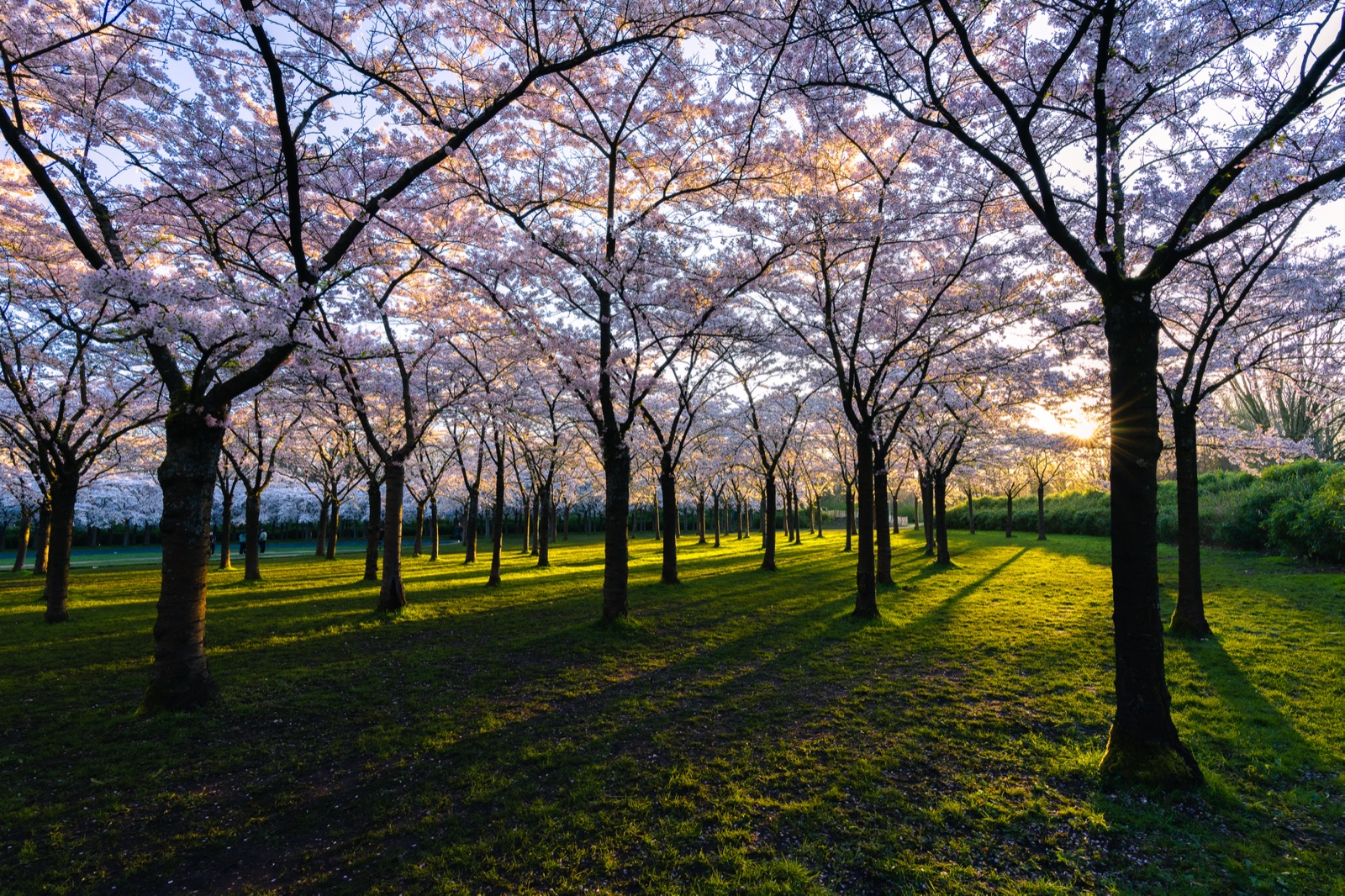
Cherry blossoms are on the tree for barely a week, and the same branch looks completely different depending on the light. Bloom timing belongs to a forecast — every region publishes one. Viewpoint takes the other half: the hours when good light falls on the trees, and the nights you can hang a full moon or the stars behind the blossom. Get both right and the shot in your head is suddenly within reach.
You stand in front of a tree in full bloom, press the shutter, and the photo comes back flatter than the memory. Almost every cherry-blossom photographer hits this wall, and the cause is rarely the blossom itself — it’s the light, the time of day, and the composition. A tree shot under flat noon sun goes chalky and white; the same tree, backlit by a low sun with the background cleaned up and cropped, reads as impossibly delicate. This guide walks the whole path: choosing the light, night blossoms, composition, and settings.
Cherry trees bloom right across the temperate world — Washington’s Tidal Basin, the avenues of Bonn, the parks of Seoul, the hillsides of Japan — and the technique that follows travels anywhere they do.
The light that makes blossom sing
Cherry petals are thin, and they transmit light. That’s the whole secret: when light comes from behind the flower — backlight — it passes through the petals and lights them from within, so the colour and texture read at their richest. The lower the sun, the stronger that transmitted glow, which is why morning and evening beat midday every time.
- Backlit, translucent petals. Put the sun on the far side of the blossom and shoot toward it. The golden hour after sunrise or before sunset is prime.
- Soft overcast light. A thin, bright overcast is a giant diffuser. Contrast drops, and the pale pinks come through evenly with no harsh hotspots. Intimate crops and close-ups are often easier on a cloudy day than under hard sun.
- Rain and fallen petals. Wet blossom, petals drifting on the wind, and a raft of them floating on still water are moods only cherry season gives you — and the damp, saturated colour is part of the appeal.
What to avoid is hard, front-lit noon sun. The flowers blow out to white, the contrast with a blue sky takes over the frame, and all the delicacy that made you stop is gone.
Night blossom and blue hour
If the trees are lit after dark, the best window is the blue hour just after sunset, not full night. While there’s still blue in the sky, the cool sky against the warm artificial light on the blossom makes a contrast that reads far better than blossom against a black void — and you have only the few dozen minutes before the sky goes fully dark.
- A tripod is essential. It’s dark, exposures run long, and hand-holding will smear them.
- Mind the white balance. Display lighting is a mix of sources — tungsten, cool white, floodlights — so don’t leave it on auto. Lock a colour temperature and shoot RAW so you can finish it later.
- Set your composition and focus before it’s fully dark. Blue hour is short and won’t wait for you.
Blossom with the moon and stars
The frame that lifts a cherry photo above the rest is a full moon rising behind a tree in full bloom, or night blossom set against the stars. Neither happens by luck — you have to know when and where the moon rises and work backward from the tree’s position.
Drop the subject (your tree) and the camera position into Viewpoint’s alignment planner, and it tells you the date and time the moon rises squarely behind it. The nights when peak bloom, a full moon, and a clear sky all coincide are few, so planning ahead is the difference between the shot and a near miss. Check the sun, moon and Milky Way almanac for the moonrise time, its bearing, and the phase — it works offline, so you can confirm the numbers standing under the tree with no signal.
Camera settings
- Aperture. To lift a single flower or one branch off a melted background, open up wide for shallow depth of field. To show a whole avenue or a landscape, stop down to around f/8 and keep it all sharp.
- Polarizing filter. A polarizer cuts glare off the petals and wet branches so the colour saturates, and it deepens a blue sky. Rotate it to taste, and go easy on ultra-wide lenses where the effect turns uneven across the frame.
- Exposure. Pale pink flowers clip to white easily, so watch the histogram and keep the highlights off the wall. Shooting a touch under and lifting in RAW is the safer play than blowing out the petals.
- White balance. To render the pink honestly, lock a warmer setting in shade or overcast. The palest cultivars are easily pushed around by ambient colour, so fine-tune in RAW.
Composition — don’t step back, choose and crop
Blossom is busy. Try to fit all of it in and the frame turns to clutter; the more you subtract, the stronger it gets.
- Crop tight, with a foreground blur. A telephoto crop of one branch, with a few near flowers thrown far out of focus into a soft foreground blur, adds depth and softness at once.
- Look up into a blue sky. Go wide, point straight up, and fan the branches out against blue. A polarizer to deepen the sky makes it snap.
- Reflections and petal rafts. Blossom mirrored in a river or a moat, or petals streaming across the surface, build quiet compositions out of symmetry or flow.
- A lone tree. A single cherry standing in a field or on a hillside is a gift of a subject — clean up the background, put only sky or a ridge behind it, and its presence carries the frame.
Knowing when to shoot
Honest version: when the trees actually bloom is down to your region’s forecast, so check the local bloom and weather forecast. What Viewpoint owns is the hours of good light — sunrise and sunset, golden hour, blue hour — and the plan to line the blossom up with the moon or stars. Peak bloom comes from the forecast; light and alignment come from the app. Scout the trees you want on a saved spot so that when the forecast finally says “this weekend,” you already know exactly where to stand.
Field checklist
- Confirm peak bloom with a local forecast, and scout the tree or avenue you want in advance.
- Chase backlit, translucent petals at golden hour, or the soft even light of an overcast day.
- For night blossom, shoot the blue hour with a tripod, a locked white balance, and RAW.
- To combine blossom and moon, work out the date and time in the alignment planner.
- Use a polarizer to kill glare and saturate colour, and protect the pale pinks from clipping.
- Don’t just step back — build the frame by subtracting: foreground blur, tight crops, reflections.