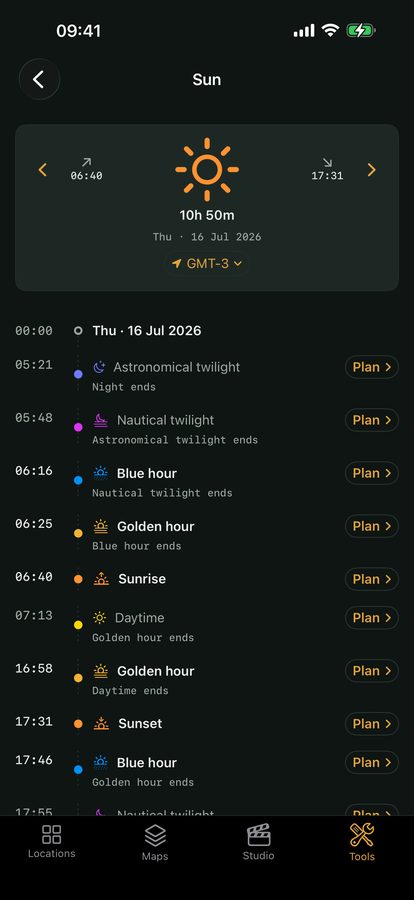
🌅 Sun · Golden & Blue Hour
How to shoot golden hour and blue hour
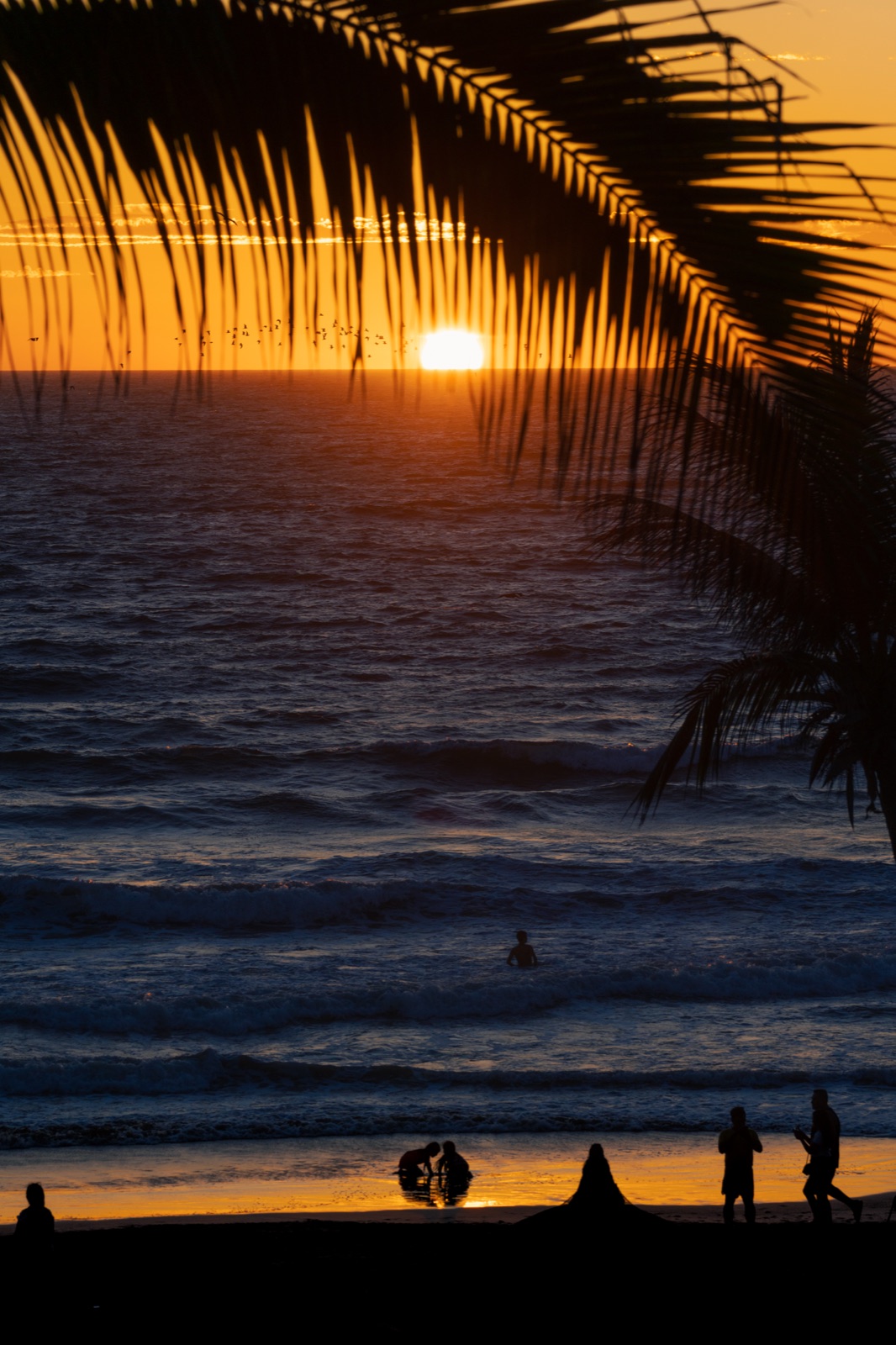
The best light of the day isn't a stroke of luck — it's geometry. Golden hour and blue hour are defined by exactly how far the sun sits above or below the horizon, which means a calendar and a compass can hand you both windows, to the minute, for any spot on Earth.
Photographers talk about golden hour as if it were a gift the weather occasionally grants. It isn’t. The warmth, the long shadows, the soft directional glow — all of it is a direct consequence of the sun’s altitude, the angle it makes with the horizon. Once you think in degrees rather than in vague phrases like “around sunset,” both golden hour and blue hour stop being something you chase and become something you schedule.
The light is set by an angle, not a clock
Every quality of outdoor light traces back to how high the sun sits. When the sun is overhead at noon, light passes through the thinnest slice of atmosphere and falls straight down — hard, colourless, full of squinting contrast. As the sun drops toward the horizon, its light travels through far more air, which scatters away the blues and leaves the warm reds and oranges behind. The low angle also rakes light across the land instead of straight down, so every ridge, ripple and blade of grass throws a long shadow that reveals texture.
That’s why the two best windows of the day are defined by altitude bands:
- Golden hour — the sun sits roughly between +6° and −4° of the horizon. Light is warm, low, soft and strongly directional. This is the headline window: side-light models three-dimensional form, colours glow, and the sky often picks up colour too.
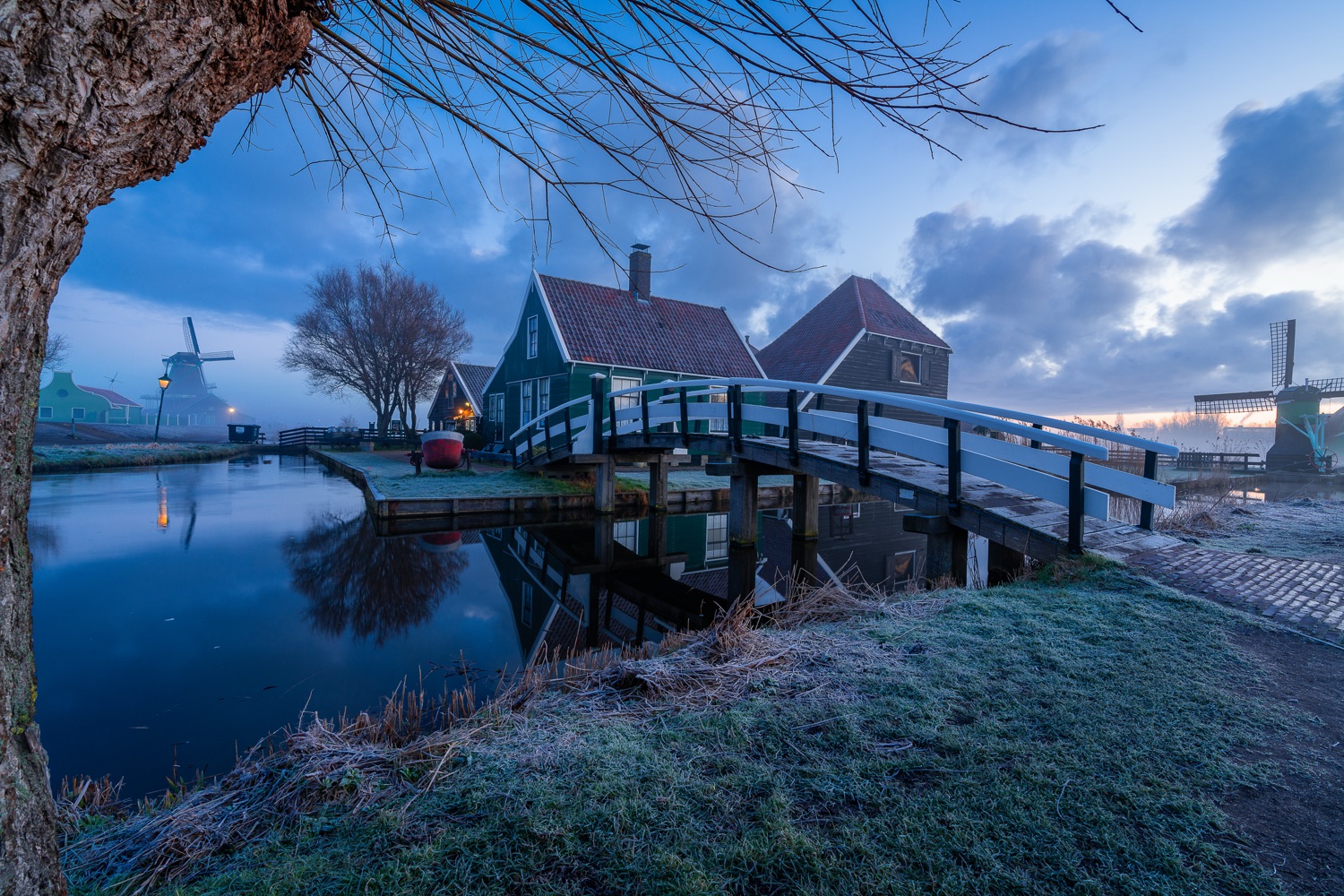
- Blue hour — the sun sits roughly between −4° and −8°, just under the horizon. Now the direct warm light is gone and the sky fills with even, cool, saturated twilight. Shadows vanish, contrast collapses, and everything takes on a calm blue cast.
Notice that golden hour spills a little below the horizon and blue hour a little further down — the transition is gradual, and the figures above are honest approximations, not hard switches.
How golden and blue hour map to twilight
You’ll see the word twilight alongside these terms, and they overlap by design. Twilight is split into three official bands by the sun’s depth below the horizon:
- Civil twilight — sun from 0° to −6°. Enough light to walk and work without a torch; the brightest stars and planets begin to appear. Blue hour lives almost entirely inside this band.
- Nautical twilight — sun from −6° to −12°. The horizon is still faintly visible against the sky; the deeper end of blue hour fades out here.
- Astronomical twilight — sun from −12° to −18°. The sky is nearly fully dark, and faint deep-sky objects begin to show.
So golden hour straddles sunrise/sunset, and blue hour sits inside civil twilight, trailing into nautical. If your goal is a star-filled sky instead, you’re waiting past all of these for true astronomical night — a different planning problem covered in our Sun, Moon & Milky Way almanac.
Why the windows get longer toward the poles
Here’s the part that trips people up: golden hour is almost never a literal hour. Its length depends on how steeply the sun crosses the horizon, which is a function of your latitude and the season.
- Near the equator, the sun drops almost vertically. It punches through each altitude band quickly, so golden hour can be as short as 40–50 minutes and blue hour briefer still. Show up late and you’ve missed it.
- Toward the poles, the sun moves across the sky at a shallow angle, grazing the horizon for a long time. At high latitudes near midsummer, golden hour can stretch for several hours, and the two windows can merge into one long, slow, coloured evening. Near the winter solstice the sun may barely clear the horizon at all, gifting a low golden glow that lasts most of the short day.
- Season amplifies this. The shallow, lingering twilights are longest near the solstices at high latitude — which is also why far-northern summers can skip true darkness entirely.
The practical takeaway: never assume “the hour after sunrise.” A window that lasts ninety relaxed minutes in Scotland in June might be a frantic forty in Kenya year-round. Always compute for your actual location and date.
What to shoot in each window — and the settings to match
The two windows reward different subjects because the light does different work. (Deciding which one to commit to on a given evening? See golden hour or blue hour: which light to choose.)
Golden hour is for texture, depth and warmth. Side-lit dunes, forests with light filtering between trunks, portraits with a soft rim of glow, mountains catching the last warm wash on their faces. Because the light is directional, where you stand relative to the sun matters enormously — front-light flattens, side-light sculpts, back-light gives you rim glows and silhouettes.
- Exposure: the scene is bright enough for low ISO. Start near ISO 100, f/8–f/11 for landscapes, and let shutter speed fall where it lands. Watch your highlights — the sun itself and bright sky can blow out fast.
- White balance: resist the camera’s instinct to “correct” the warmth. Auto white balance often neutralises the gold you came for. Shoot RAW and either dial in a fixed warm balance (around 5500–6500 K) or fix it later. RAW means white balance is a free, lossless decision after the fact.
Blue hour is for mood, water and city lights. The even, shadowless light suits cityscapes where artificial lights balance the deep-blue sky, long-exposure seascapes where the soft light smooths the scene, and any composition that wants calm over drama.
- Exposure: light is fading fast, so you’re into longer shutter speeds — often several seconds. A tripod is essential, and a remote release or a 2-second timer stops shutter shake.
- White balance: the blue is the point, so keep it cool — but if it goes too far toward muddy, nudge warmth back in. Again, RAW makes this a decision, not a commitment. Expose for the sky and let the foreground sit darker; it reads naturally at twilight.
In both windows the light changes by the minute, so bracket your exposures and keep shooting — the frame two minutes after the one you thought was best is often the keeper.
Planning the sun’s direction and position
Knowing when the window opens is only half of it. The other half is where the sun will be — its compass bearing, or azimuth — because that decides which face of your scene gets lit.
The sun’s rise and set points drift across the year: north in summer, south in winter (in the northern hemisphere, and reversed in the southern). A valley that catches a perfect side-lit glow in June may be entirely back-lit or in shadow by December. So a good plan answers three questions: when does the window open, how long does it last at this latitude and season, and from which direction will the light arrive.
This is exactly what a planning tool is for. Viewpoint’s alignment planner lets you stand a future sunset against a specific peak, archway or street so you can check the geometry before you commit to the drive. And because the windows are so predictable, you can pin the day’s golden and blue hour times right to your home and lock-screen widgets — a glance tells you when to leave, no app-opening required.
The one thing to remember
Both windows are predictable to the minute for any location and date, because they’re pure astronomy. There’s no guesswork in when — only in the weather, your composition, and whether you got there early enough. Arrive before the window opens, because the most striking light is often in the few minutes right around the boundary: the instant of sunset, or the deepest part of the blue.
Quick-start checklist
- Think in degrees, not clock times — golden hour ≈ +6° to −4° sun altitude, blue hour ≈ −4° to −8°.
- Compute for your exact spot and date — the window’s length swings from ~40 minutes at the equator to hours near the poles in summer.
- Shoot RAW so white balance stays a free decision; keep golden warm (~5500–6500 K), keep blue cool.
- Golden hour: low ISO, f/8–f/11, mind your highlights, use side-light to reveal texture.
- Blue hour: tripod up, expect multi-second exposures, expose for the sky.
- Check the sun’s azimuth for the season — confirm the light will actually hit the face you want lit.
- Arrive early and keep shooting — the best frame is often right on the boundary.