🌅 Sun · Golden & Blue Hour
How to predict a fiery sunset
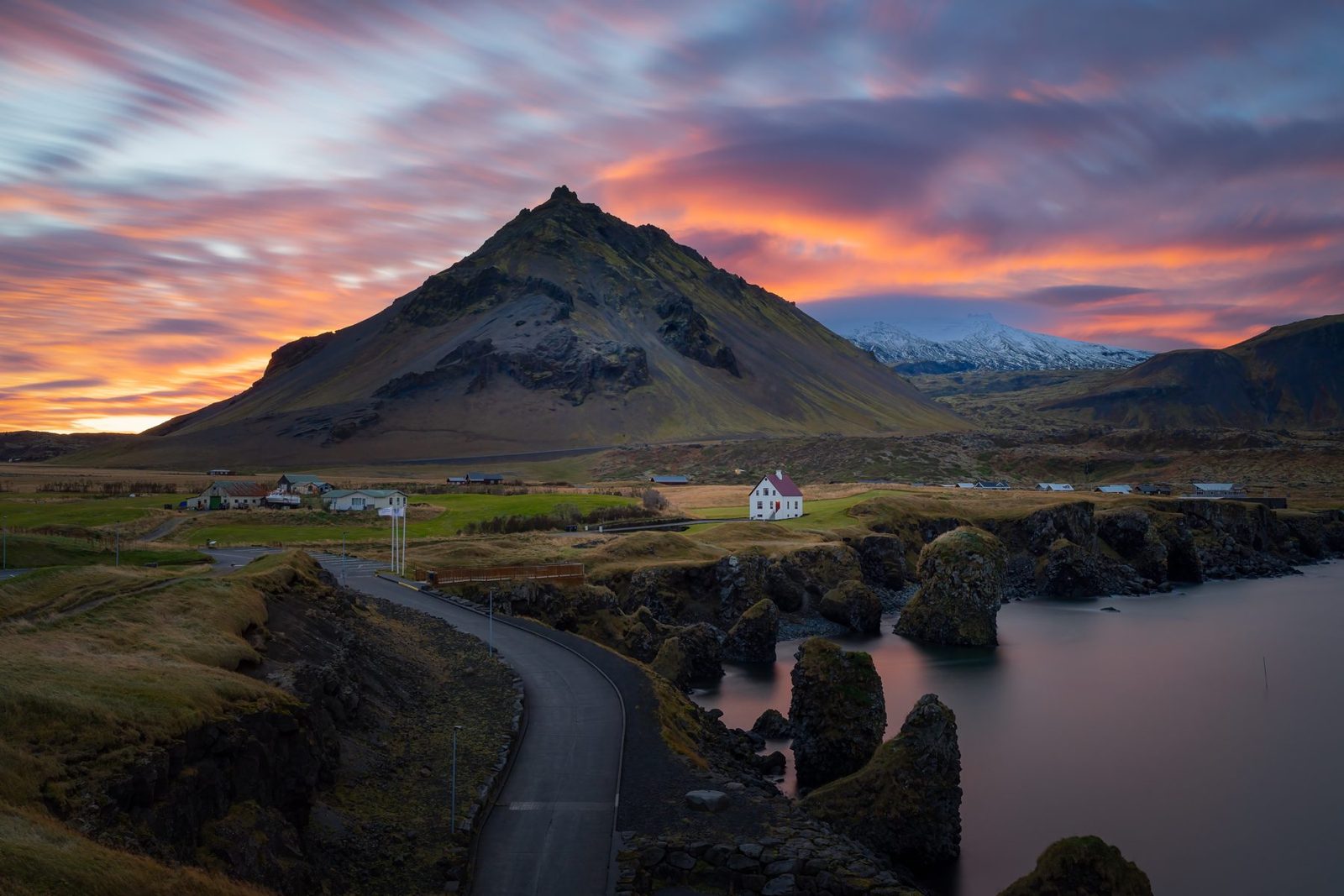
Some sunsets are a quiet gradient, and some set the whole sky on fire. The difference is rarely luck and never the sun: it is a particular arrangement of cloud, air and horizon that you can read in a forecast the day before and check again an hour ahead. Here is what that arrangement is, which numbers show it, and how to be standing in the right place for the few minutes it counts.
A clear sky gives you a clean, pale sunset. A thick overcast gives you nothing. The fire lives between the two, and it lives in a very specific place: clouds that are lit from below by a sun you cannot see. If you understand that one sentence you can predict most good evenings — and you will stop being disappointed by the cloudless ones.
What actually makes the colour
When the sun is on the horizon its light crosses a long path of atmosphere, and the blue is scattered away on the way. What is left is orange and red light — but light has to land on something to be seen. A clear sky has nothing to catch it. A cloud does.
So you need two things:
- Clouds for the light to land on — and they need to be high enough to still be in direct sunlight after the sun has set at ground level.
- A clear path for the light to reach them — a gap at the horizon, in the direction of the sun, so the light can slide in underneath.
Without the first, the sky is a gradient. Without the second, the cloud deck is grey: the sun is blocked before it can reach it. With both, the underside of the cloud glows, often for ten or twenty minutes after the sun has gone — the afterglow, which is frequently better than the sunset itself.
Read the cloud by layer
Forecasts split cloud into low, mid and high layers. That split is the whole game.
- High cloud (cirrus, cirrostratus, about 6 km up and above) is the best canvas. It stays lit longest, lights up pink and magenta, and a scattering of it adds streaks and texture. A thin veil of it adds colour; a thick sheet of it mutes everything.
- Mid cloud (altocumulus, the “mackerel” sky) is the second-best. Its small, separate patches take the colour well and give the sky structure.
- Low cloud (stratus, stratocumulus) is the spoiler. A low deck on the horizon in front of the sun cuts the light off before it can reach anything. A low cloud overhead matters less than one on the horizon where the sun is going down.
The sweet spot is usually partial cloud — somewhere around a third to two-thirds of the sky, mostly mid and high, with the western horizon open. Fewer than that and there is nothing to light; more and the sun is blocked. This is also why a forecast of “mostly cloudy” can be a better sunset than “clear.”
The gap on the horizon is the deciding factor
You can have a beautiful cloud canvas and lose the sunset to a single strip of low cloud on the horizon. The sun sets at one precise compass bearing, and what is there — 100 or 200 kilometres away, which is how far the light travels low across the land — decides whether the show happens. The same logic runs in reverse for sunrise, with the east in front of you.
That is why two things are worth knowing:
- Where the sun will set from your spot. It moves along the horizon through the year, by many tens of degrees. Look up the bearing for the date and see whether it points over open land, water or a hill. How to plan the sun’s position shows how.
- What the weather is doing in that direction. In mid-latitudes weather mostly arrives from the west, so for a sunset, cloud building on the western horizon in the afternoon is bad news and a clearing edge is good news. For sunrise the horizon you care about is the east, and you have less warning: check it as early as you can.
The air matters too
Clean, clear air gives you saturated, high-contrast colour. A little haze or fine particles in the air can push the colour redder and deeper, especially at the very edge of the horizon — which is why a dusty or hazy evening can produce a deeply red sun. Heavy smoke or thick haze is different: it flattens everything and dims the sun to a disc. After rain, when a front has passed and washed the air, you often get the cleanest, most vivid light of all — and it is the classic case for the clearing-storm sunset (see storm light).
Timing: the best part comes after
Photographers who leave when the sun touches the horizon miss it. Colour on the clouds builds as the sun drops below the horizon and usually peaks somewhere from the moment of sunset to about twenty minutes after, depending on your latitude and the cloud height. That window runs from golden hour into the first of blue hour: see golden hour and blue hour for how the light changes through it.
Practically: be at your spot before the colour starts (a good half hour early), compose while the light is still plain, and stay put until the cloud has gone dark. Many of the best frames are made after everyone else has gone to dinner.
What no forecast can tell you
Be honest about the limits. A forecast can say the arrangement is likely; it cannot promise it, because the one thing that decides it — a thin strip of cloud at the horizon, a hundred kilometres away — is below what the models resolve. Treat it as odds. A good rule: when the layers look right the evening before, set up; when they look right at lunchtime, go and look; when the western sky is opening an hour before sunset, run for your best open viewpoint. And look at the sky yourself in the last hour, because a forecast made twelve hours earlier is not the sky you are standing under.
How Viewpoint helps
The geometry is the part you can calculate: where the sun will set, how long golden and blue hour last, when first and last light fall. The calculators and the almanac in Viewpoint work that out on your device for any place and date, free and offline.
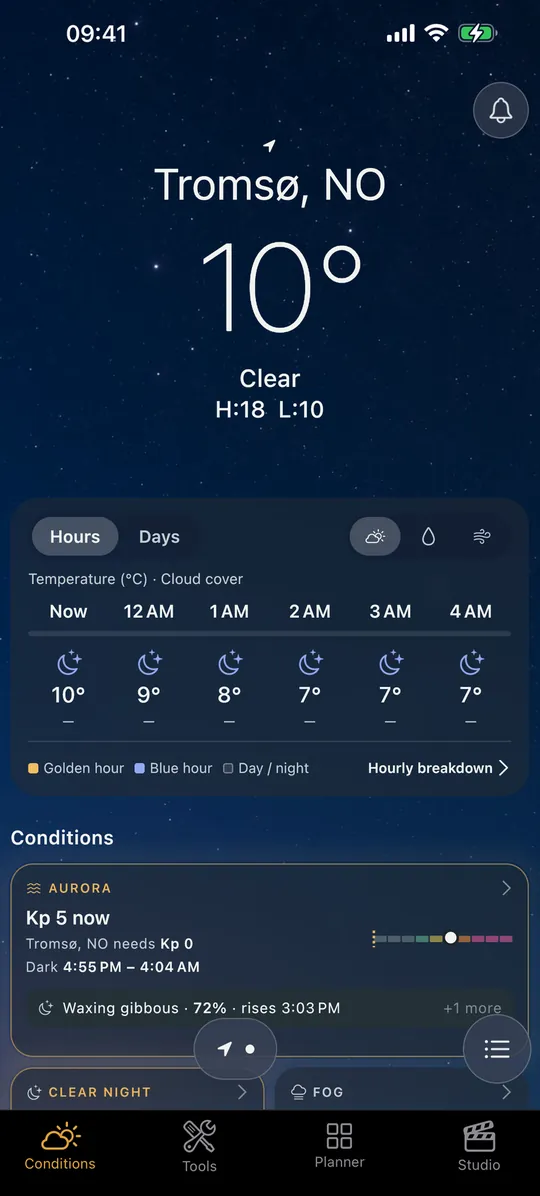
The weather is the part you need a forecast for. In the Conditions tab each place you follow has its own page with the hours ahead, golden and blue hour marked along the strip, and a golden light tile with the hours that look best and the numbers behind them. Turn on an alert for a place and Viewpoint tells you when a good evening is on its way, so you can plan a drive around the sky rather than discover it from the car. Conditions needs an Online subscription; the calculators and almanac do not.
Quick-start checklist
- You need clouds to catch the light and a gap on the horizon for the light to reach them.
- High and mid cloud are the canvas; low cloud on the horizon is the spoiler.
- Aim for partial cloud — roughly a third to two-thirds of the sky — with the horizon open toward the sun.
- Know where the sun will set from your spot on that date.
- Clean air after rain gives the cleanest colour; heavy haze or smoke flattens it.
- Arrive half an hour early and stay for the afterglow — the peak is often after sunset.
- A forecast gives odds, not a promise; check the real sky in the last hour.