🎨 Editing & Processing
Is sky replacement cheating? The line between editing and faking
One click now swaps a dull grey sky for a dramatic sunset, drops a giant moon behind a mountain, or fills a blank night with a Milky Way. It raises a question every landscape photographer eventually has to answer for themselves: is that cheating? The honest answer isn't a rule about which tools you're allowed to touch — it's about disclosure, and about the difference between developing the light you captured and inventing light that was never there. Here's a clear way to think about the line, and why the most satisfying answer is to plan the real shot instead.
Editing tools have made one particular move trivial: replacing the sky. Select the dull sky, swap in a dramatic one from a library, and the software blends the edges automatically. The same technology drops an oversized moon behind a ridge or paints a galactic core into an empty night. It looks convincing — and it puts a genuine question in front of every landscape photographer: where’s the line between processing a photograph and manufacturing one? It’s worth having a clear answer, both for your own conscience and because competitions, clients and audiences increasingly ask.
Where the line actually is: disclosure, not technique
The unhelpful version of this debate argues about tools — “real photographers don’t use X.” That’s a dead end, because every photograph is processed: a RAW file is developed, contrast is added, colours are shaped. The useful line isn’t which slider you touched; it’s honesty about what the image represents.
A photograph carries an implicit claim: this is a scene I witnessed. You can strengthen that scene — dodge and burn, blend exposures, reduce noise, adjust colour — and it’s still an honest rendering of a real moment, because everything in the frame was there. The line is crossed when you add elements that were never in front of the camera and present the result as if they were. The test isn’t “did you edit it?” — it’s “would a viewer feel deceived if they knew what you did?”
Legitimate craft: blending and stacking your own frames
By that test, a lot of “heavy” editing is completely honest:
- Exposure blending — combining a bright-sky and dark-foreground frame of the same scene to hold the range your eye saw. Real light, real place.
- Stacking — averaging several frames of the same night sky to cut noise. It’s your sky, just cleaner.
- Focus stacking, panoramas, dodging and burning — all combine or shape frames you actually shot, of the scene that was actually there.
None of these adds anything that wasn’t in front of the lens. They’re the digital darkroom equivalent of what film photographers did under the enlarger. Legitimate craft.
Sky and moon replacement: what the competitions ban
The other side is just as clear. Dropping in a sky photographed on a different day and place, or compositing a moon at a size and position it never held, adds elements that weren’t there and presents them as real. That’s why nature and landscape competitions almost universally ban it, and why doing it undisclosed in professional or editorial work is treated as a serious breach. It’s not that the images are ugly — it’s that they make a claim (“this is what I saw”) that isn’t true.
The moon-size illusion — why that “huge moon” is usually a composite
A specific tell worth knowing: those photos of an enormous moon looming behind a small subject are almost always composited, because a big moon and a sharp foreground can’t be captured in one frame without careful planning. A moon large in the frame needs a long lens, which makes the foreground tiny or soft; getting both sharp and correctly sized takes distance, alignment and timing. So most “impossible moon” shots are two images stuck together — impressive, and fake. The real version exists, but it’s planned, not pasted.
Getting the real shot instead
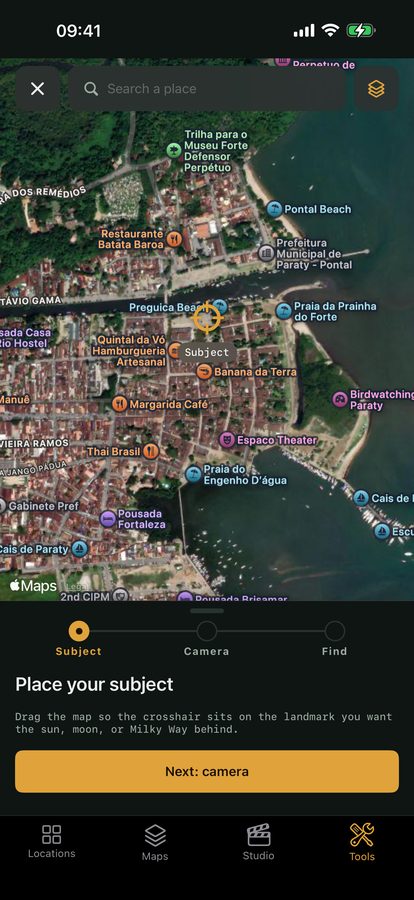
Here’s the satisfying resolution: the dramatic sky, the giant moon behind the peak, the Milky Way arcing over the ridge — you can shoot them for real, and the result beats any composite because it actually happened. It just takes planning. Knowing where to stand and when so the moon rises exactly behind your subject, or the galactic core sits over your foreground, turns an “impossible” composite into a real photograph. That’s the whole idea behind Viewpoint: it computes the real alignments and the real light, so you plan to be in the right place at the right moment. Get the real shot and the ethics question evaporates — there’s nothing to disclose, because nothing was faked. (Planning the Milky Way over your scene is exactly this kind of real-alignment problem.)
If you do composite, disclose it
None of this makes composite art wrong — digital art and surreal composites are a legitimate creative form. The line is only crossed by passing a composite off as a straight photograph. If you swap a sky or drop in a moon for the look, own it: label it as a composite or digital art. Disclosed, it’s creativity; undisclosed, it’s deception. That single habit — say what you did — resolves almost every version of this debate.
Quick-start checklist
- The line is disclosure, not tools — the test is “would a viewer feel deceived if they knew?”
- Blending, stacking, focus stacking, panoramas of your own frames are honest craft — nothing added.
- Replacing skies or compositing a moon adds what wasn’t there — banned in competitions, deceptive if undisclosed.
- A giant moon behind a small subject is almost always a composite — the real version needs planning.
- Plan the real alignment — the genuine shot beats the fake and needs no disclosure.
- If you do composite, label it — disclosed, it’s art; undisclosed, it’s deception.